
Shaker Heights City Directory Holdings
The best historical directory work starts by choosing the correct series, not by treating every Cleveland volume as a Shaker Heights source. Cleveland Public Library holds a broad Cleveland run, while later suburban titles name Shaker Heights more precisely. The sequence matters because a change in title does not mean the local record stopped. A volume can identify a listed adult, business, address, or occupation for one publication period, but it is not an ownership record or a complete household census.
| Collection | Years | Where Held | Access |
|---|---|---|---|
| Cleveland volumes, including Cleveland Directory Co. | 1837-1977; Shaker Heights explicitly named 1925-1950 | Cleveland Public Library Center for Local and Global History and Digital Gallery | Complete microfilm run; selected digitized volumes |
| Cleveland Heights, East Cleveland, Shaker Heights, University Heights and South Euclid series | 1949, 1951, 1953-1956, 1958-1963 | Cleveland Public Library | Microfilm |
| East Suburban Directory | 1964, 1965, 1967-1972, 1976, 1978/79 | Cleveland Public Library | Paper and microfilm |
| Cleveland-area criss-cross and telephone directories | Criss-cross print 1923-1926, 1960-1993, 1996-2010; telephone directories 1880-present | Cleveland Public Library | Print and microfilm runs; listed subscribers only |
The parent directory began in 1837, but Shaker Heights was explicitly named only from 1925 through 1950. The local title from 1949 through 1963 and the East Suburban continuation keep the trail moving. Preserve a gap instead of declaring a person absent: Cleveland proper did not publish in several years, including 1933, 1945-1946, 1948-1950, 1952, 1962, 1967, 1971, 1973, and 1975-1976.
Shaker Heights Public Library’s Local History collection inventory shows the related local materials available beside the directory series.
The library collection gives a local bridge when a directory entry needs school, association, building, or newspaper context.
Shaker Heights City Directory Series
Cleveland Public Library’s directory guide is the useful route for the main series, the address sections, and the criss-cross volumes. Its holdings separate digitized material from volumes that still require microfilm or paper access. The digitized 1930 Cleveland volume is one example whose title page expressly includes Shaker Heights. It has alphabetical private-citizen and business listings, a householders and office-business-occupant directory, a street-and-avenue guide, and classified material.
Cleveland Public Library’s digitized 1930 directory provides an online example of the historical format.
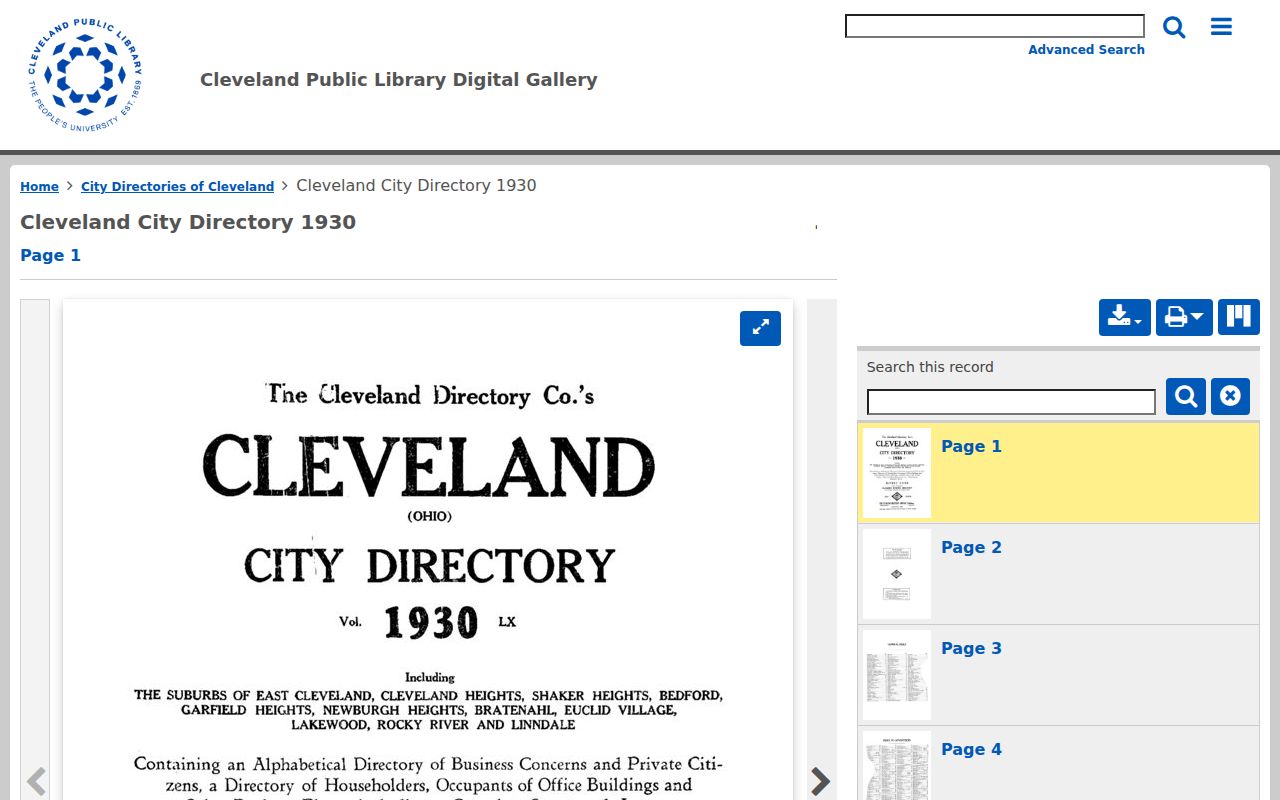
Digital access is helpful for a known volume, while the microfilm shelf remains important for runs that have not been placed online.
For regional backup, Cuyahoga Archives holds directories from 1837 to 1972, although the holding is not inclusive. The Western Reserve Historical Society has Cleveland and east-west suburb directories from 1837 to 2000. Both are supplements, not proof that any given year covers every Shaker address.
Note: A change in publisher or title is a cue to check the next series, not evidence that a household left Shaker Heights.
Shaker Heights Local History Desk
The Moreland Room at Shaker Heights Public Library is a direct local channel for a directory question that needs context. It is at the Main Library, 16500 Van Aken Blvd., and the published Local History hours are Monday 2-4 p.m., Tuesday noon-3 p.m., and Wednesday 2-4 p.m. Availability should be confirmed before a visit. Researchers can contact the desk at localhistory@shakerlibrary.org or 216-991-2030 ext. 3016.
The Library’s Local History overview describes its City, school, community organization, institution, people, and library collecting scope.
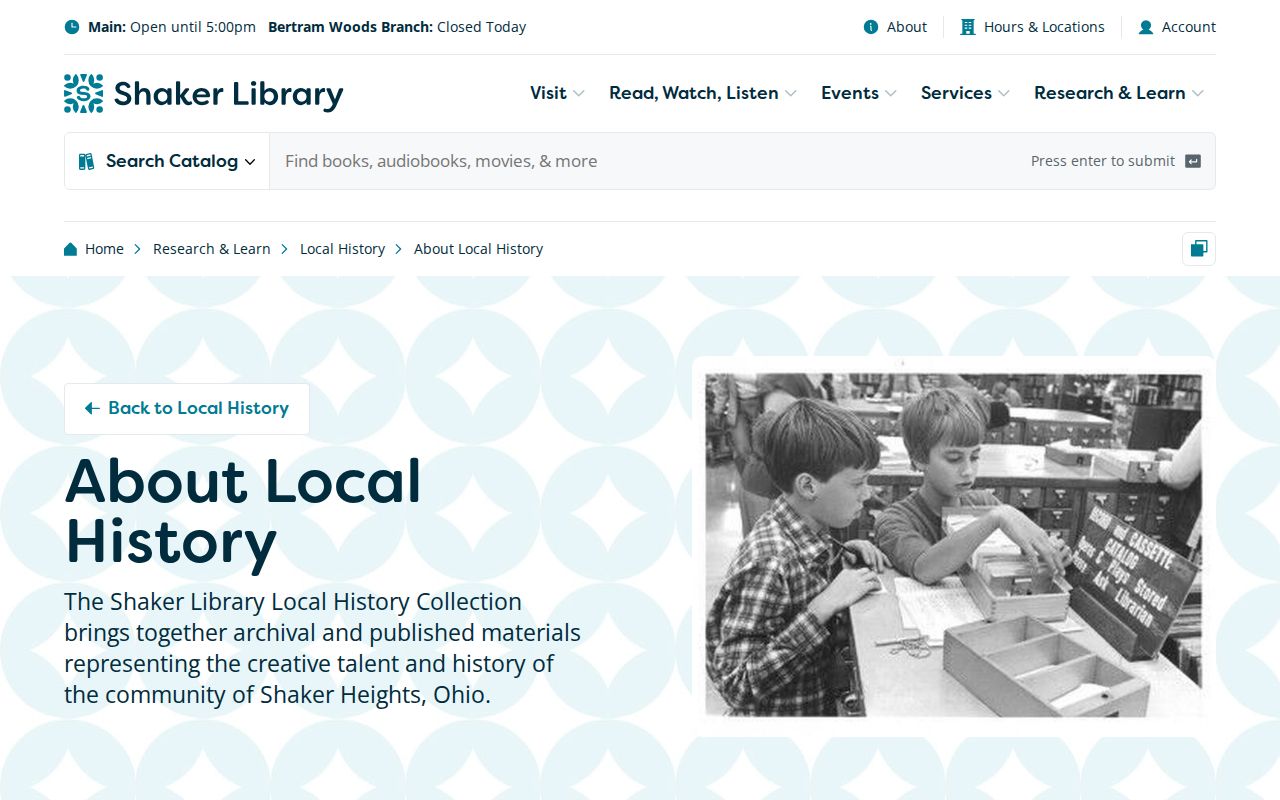
That scope makes the desk a good fallback for a local address or family question that a directory alone cannot settle.
Shaker Historical Society’s Elizabeth Nord Library & Archives is another channel. It is free by appointment and accepts research requests at collections@shakerhistory.org. The first 15 minutes of staff work are free; further research is listed at $25 per hour with a $25 nonrefundable first-paid-hour deposit. Its maps, vertical files, photographs, and North Union Shaker material can complement, rather than replace, a directory citation.
Shaker Heights City Directory Entry Keys
Read an entry as the publisher’s compact observation, then preserve the abbreviations exactly. In the inspected 1930 volume, an alphabetical listing can give a surname, given name or initials, a spouse in parentheses, occupation or employer, and a home or residence address. The directory uses h for home and r for residence. A sample uses (SH) for Shaker Heights, and wid followed by a husband’s given name is a widow notation.
| Person name | Surname followed by given name or initials; a spouse can appear in parentheses. |
|---|---|
| Work detail | Occupation and sometimes an employer, useful for separating people with the same name. |
| Address mark | h means home and r means residence in the inspected volume. |
| Locality cue | (SH) is a Shaker Heights abbreviation in the sample, but each volume’s key controls. |
| Status and ownership | wid supplies a widow clue; the listing does not establish ownership, renter status, or every occupant. |
- Criss-cross directory
- An address-first directory arranged to connect a street address with a listed adult, business, or telephone number for that edition.
- Householder index
- A section that organizes listed householders or occupants, often alongside business material, rather than a modern census roster.
- Abbreviation key
- The publisher’s legend for short forms and locality marks. Check and copy it before drawing conclusions from an entry.
Note: An entry connects a listed adult or business to an address at publication time, not to a complete household or a legal title record.
Shaker Heights Criss-Cross Directories
For a historic address, the criss-cross volumes reverse the usual alphabetical-directory question. Start with the street and number, then capture the listed adult, business, or telephone number exactly as printed. Cleveland-area criss-cross directories exist in print for 1923, 1925, 1926, 1960-1993, and 1996-2010; Library microfilm covers 1923, 1926, 1960-1993, 1996-1998, and 2009-2012. Local city and suburban volumes also began carrying address sections in 1929.
A listed subscriber may not be every adult at the address, and an unlisted number leaves no entry. For a current parcel relationship or a full street-by-street records trail, use the separate Shaker Heights street directory lookup instead of stretching a historic volume past its purpose.
Tracing Shaker Heights Directory Volumes
To trace a household, build a dated sequence rather than copying one attractive entry. A move, a spouse notation, a changed occupation, or a different form of the name may be the transition that connects two records. The latest public federal census is 1950, so census schedules work best as periodic checks between annual or near-annual directory appearances. Deeds, plat books, and probate records can test a family-history conclusion when a name moves through an address.
- Find the earliest likely alphabetical entry, recording the exact title, year, spelling, locality abbreviation, and address.
- Check nearby volumes and follow name variants, a spouse’s name, and widow notation rather than assuming the spelling stays fixed.
- Use the address section or a criss-cross directory to see what the particular edition lists for the same address.
- Pair the sequence with the 1950 or earlier federal census, then compare a move with Shaker Library plat maps or County transfer records.
- Where a death or estate changes the trail, use the historic death index or Probate Court record path and verify the official file.
A name disappearing can reflect a move, a death, a changed edition, an unlisted telephone number, or a year that was never published. When a historical listing needs a modern confirmation, a cautious Shaker Heights resident lookup uses record types suited to a single person rather than treating the old listing as present residence evidence.
Note: Record the volume title and publication year with every address finding, because directory coverage and household completeness vary from edition to edition.
Shaker Heights Neighborhood Archives
City-recognized names such as Boulevard, Fernway, Lomond, Ludlow, Malvern, Mercer/Thornton Park, Moreland, Onaway, and Sussex are useful archive-routing labels. They are not ZIP boundaries and do not establish a person’s membership in a community group. Shaker Library holds association and integration-related material, while its local newspaper runs include incomplete Shakerite microfilm from 1929 forward and incomplete Sun Press/Heights Press microfilm from 1936 through 2010.
Shaker Library’s online history resources identify digital and archival paths for that broader community context.
Use a newspaper, yearbook, or oral-history result as dated context and keep it distinct from evidence of a person’s residence.
Shaker Heights Directory Timeline
The directory timeline reflects the City’s later municipal history and the older regional record system around it. The County’s recorded-document history reaches to 1810, while Shaker Heights formed as a Village in 1911, incorporated in 1912, and became a City in 1931. For directory work, the clear milestones are the first parent Cleveland directory in 1837, explicit Shaker naming from 1925, the address section from 1929, the dedicated five-suburb title from 1949, and the East Suburban series from 1964.
| 1837 | First parent Cleveland directory begins, before explicit Shaker Heights naming. |
|---|---|
| 1925-1950 | Parent directory explicitly names Shaker Heights. |
| 1929 | Address section begins in Cleveland and most suburban directory volumes. |
| 1949-1963 | The dedicated five-suburb series supplies a more specific local sequence. |
| 1964 | East Suburban Directory begins as the documented successor series. |
Shaker Historical Society’s collections inventory also reflects a current expansion in local archival access through its CatalogIt digitization work.
Nearly 800 Society items were public by December 2025, with incomplete or minimally processed entries labeled as such, so a catalog result still needs collection-level reading.